
Uncategorized
Gates of Olympus draws its whole essence from Greek mythology, and the theme influences every mechanical choice in the game https://gatesolympus.in/. The reels sit inside a temple bordered by marble columns and floating clouds, while Zeus himself emerges as the central figure who can increase wins during any spin. This setting is not merely decorative; the symbols, sound cues, and win animations all underscore the idea that divine intervention can change the outcome at any moment. Players who grasp how the mythological layer connects to the actual mechanics will identify opportunities faster than those who view the visuals as background noise. The temple backdrop also changes lighting during big wins, shifting from daylight to a golden dusk that signals a multiplier chain is about to settle.
Reels, Rows and Ways to Victory
The arrangement uses a 6-reel five-row grid that pays through a scatter-pay system rather than fixed lines. Any eight or more matching symbols anywhere on the screen create a win, and the symbols then disintegrate to let new ones drop into place. This tumble mechanic repeats until no new combinations emerge, which means a single paid spin can generate several consecutive wins. Because every symbol position counts, the total number of ways to win reaches well above 100 000 combinations on every spin. Players should monitor the cluster size carefully; eight low-paying coins may pay less than five high-paying helmets, so symbol value matters as much as quantity. When a tumble chain hits four consecutive drops, the screen briefly enlarges to highlight the growing multiplier trail, giving players an instant visual cue that the payout is increasing.
The lack of traditional paylines also alters how we evaluate near-misses. A cluster of seven matching symbols seems close to a win, yet the game treats it as a complete miss. Understanding this distinction avoids the common mistake of reading momentum into a result that the math does not support. Over longer sessions the scatter-pay model tends to produce more frequent but smaller clusters in the base game, while the larger payouts arrive when multipliers land inside those clusters. Keeping a mental note of how often eight-symbol groups emerge helps us judge whether the current reel rhythm is running hot or cold.
Wild Multipliers and Chance Events
At the beginning of any spin there is an opportunity that Zeus will cast lightning bolts onto the grid. Every bolt lands on a random spot and attaches a multiplier between two times and five hundred times. If a winning cluster subsequently hits that spot, the attached multiplier affects the entire tumble sequence. Multiple bolts can stack, so a single tumble chain can gather several multipliers that multiply with each other rather than add. The mechanic may activate on both paid spins and free spins, which means the base game already includes a built-in surprise element that impacts bankroll swings. A bolt with a multiplier of one hundred times or higher can turn an otherwise average cluster into forums.redflagdeals.com a payout that compensates for dozens of previous dead spins.
Where bolts land is random, yet certain visual tells appear just before they land. The sky dims for a split second, and a faint crackle sound plays even if the bolt ultimately misses any winning cluster. Veteran players rely on this signal to get ready for the possibility of a large swing, either by observing the current bet or by deciding whether to watch the next few spins more closely. Because the multiplier remains on screen until used, it also acts as a persistent reminder that the next tumble might be valued significantly higher than the stake alone suggests.
Max Win Thresholds and Cap Behaviour
The game applies a maximum payout cap of five thousand times the stake in a single spin sequence. Once the accumulated total hits this ceiling, further tumbles continue only for entertainment, and any excess is discarded. Reaching the cap necessitates a combination of high-value clusters and stacked multipliers above two hundred times. While the theoretical top win stays rare, the presence of the cap shapes strategy: players who observe multipliers already exceeding one hundred times may opt to raise the stake for the remaining spins in order to convert the same reel outcome into a larger absolute payout before the cap is hit. The cap refreshes on the next paid spin, so the decision to increase the bet must be executed while the current sequence is still live.
Because the cap is applied after all multipliers have been computed, a tumble chain that would have reached six thousand times is simply truncated. This truncation can seem abrupt if the screen continues to animate wins that no longer add to the balance. Watching the win counter closely once it passes three thousand times helps us foresee whether the next drop will push the total over the limit. If the counter is already climbing rapidly, holding the current stake prevents the disappointment of unpaid spins, while a modest increase can capture more of the sequence before the ceiling is reached.
Sound Engineering and Visual Cues
Audio cues are tied directly to machine actions. A low chime sounds when gems create a cluster, while a deeper percussion hit signals a helm or ring win. When Zeus throws a bolt, the screen shades for a split second and a thunder crack validates the multiplier placement. These cues help experienced players take in information without always checking the win counter. The same audio layer also marks the transition into free spins with a longer orchestral swell, allowing anyone using headphones to detect the round change even if they glance away from the screen. The pitch of the chime goes up slightly with each successive tumble, giving an audible indication of how many drops have already occurred in the present sequence.
Visual cues supplements the audio through colour flashes that match the symbol tier. Lower-tier gem wins produce a short white flash, while high-tier wins trigger a golden burst that lingers for 0.5 seconds. When a multiplier over fifty times is applied, the whole grid receives a subtle blue tint that dissolves only after the payout is added. These stacked indicators create a coherent language that reduces the need to check numbers during fast play. Over time the combination of sound pitch and colour intensity becomes an virtually automatic cue of whether the ongoing tumble is worth observing until the end.
Bonus Spin Bonus Round Rules

Getting four or more scatter symbols, represented by the temple gates, awards ten initial free spins. During the round every multiplier bolt that arrives gains an extra life and stays on the grid for the rest of the feature. If a bolt hits five hundred times it remains until the free spins end, creating the chance of a lasting high multiplier that affects every following tumble. Retriggers occur whenever three additional scatters show up, giving five more spins without clearing the collected multipliers. The round consequently rewards patience; the more extended the feature lasts, the higher the cumulative multiplier ceiling grows. A single five-hundred-times bolt that survives eight or nine spins can transform even low-value gem clusters into substantial returns.
Retrigger frequency usually grow once two or more high-value bolts are presently on the grid, because the larger multipliers produce more visible win celebrations that maintain players engaged. The game does not show a clear counter for remaining spins, so concentration to the bolt count turns into the main signal of how much longer the round may last. When three or more bolts rest above one hundred times, the remaining free spins often deliver the session’s largest single payout, even if the actual cluster sizes remain modest. Monitoring these bolts helps us gauge whether extending the session after the feature ends is expected to replicate the same level of excitement.
Core-Game Symbols and Payout Values
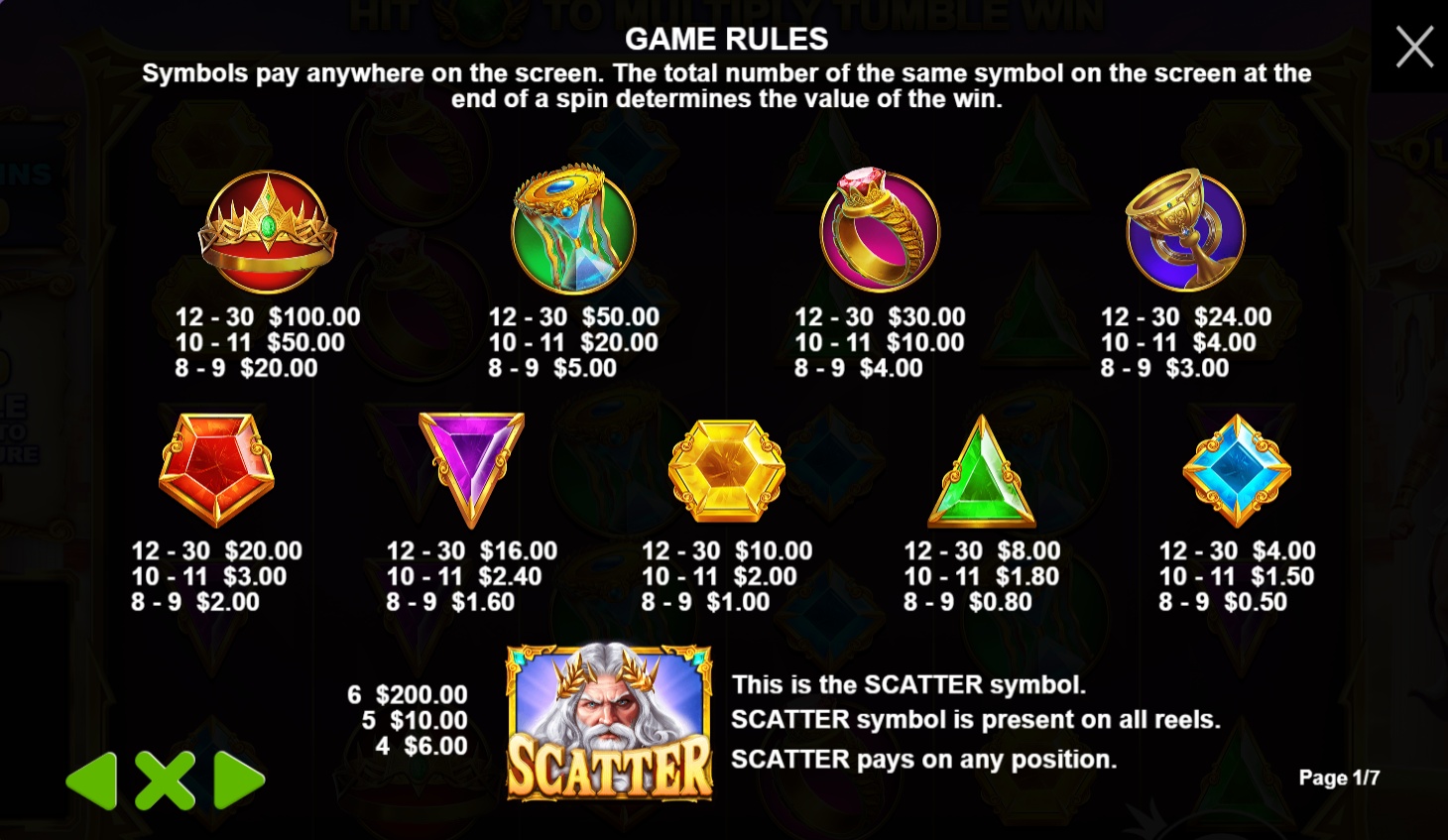
The paytable splits into two tiers. The lower tier contains coloured gemstones that return between 0.2 times and 0.8 times the stake for twelve matching symbols. The upper tier includes mythological items such as a golden gauntlet, a helm, and a ring, each returning between two times and twenty times the stake for the same cluster size. Zeus shows up only as a special symbol and never makes line wins; instead he activates the multiplier feature. Knowing the exact thresholds assists players choose when to boost or reduce their bet, because the gap between a gem win and a helm win can go beyond a factor of ten on identical cluster sizes. A twelve-gem cluster at the lowest stake provides just enough to keep the balance moving, whereas the same number of rings can surpass the entire starting stake in one tumble sequence.
Colour coding on the gems also acts as a quick reference for value. Blue stones sit at the bottom of the pay scale, while purple stones occupy the top of the low tier. When the reels slow after a tumble, the eye naturally registers the dominant colour first, giving an immediate hint about whether the payout will be modest or substantial. This visual shorthand grows useful during rapid tumble chains where there is little time to count symbols before the next drop begins. Over hundreds of spins the pattern recognition accelerates decision-making about whether to boost the stake or stay patient.
Bet Range and Stake Adjustments
Wager amounts typically begin at twenty INR per spin on India-oriented platforms and scale upward in ten-rupee steps until reaching the local equivalent of five thousand INR. The extensive range allows both occasional players and high-stakes players to discover a comfortable level without switching games. Because the tumble mechanic can produce several wins from one wager, adjusting the bet mid-session influences every subsequent tumble equally. Users typically start at the bottom end to monitor the rate of Zeus involvement before committing larger amounts during a session that already displays active multipliers. A rise from twenty INR to fifty INR can amplify a hundredfold multiplier from a modest return into a payout that covers an whole night’s gaming.
Mid-session stake changes also interact with the maximum win cap. Boosting the wager after a large multiplier has already landed threatens hitting the en.wikipedia.org 5,000x cap more quickly, which can make later tumbles unrewarded. Conversely, decreasing the wager after a long dry spell diminishes the expense of continued testing while the reel rhythm remains quiet. We have discovered that a single wager modification at the 30-spin point, determined by bolt occurrence, often generates a smoother bankroll curve than multiple small tweaks throughout the session.
RTP and Variance Overview
The published return-to-player figure stands at 96.5 percent, which positions the game slightly above the current average for video slots. That figure is determined over millions of spins, so short sessions can swing sharply. Volatility is rated high, indicating the distribution of outcomes favours infrequent but larger payouts. During testing, dry spells of twenty to thirty spins are common, yet the same session can produce a multiplier chain that goes beyond one hundred times the stake. Players who favor steady small wins may discover the swings uncomfortable, while those who accept variance can synchronize their session length with the mathematical rhythm of the title. We have observed sessions where the first twenty-five spins returned nothing, only for spins twenty-six through twenty-eight to produce a combined payout above eighty times the stake.
Because the RTP is an average, the game can appear stingier or more generous depending on the chosen stake level and the timing of Zeus interventions. A player who starts during a period of frequent lightning bolts will undergo a higher effective return than someone who endures a stretch of empty spins. Tracking the interval between bolt appearances over the first fifty spins gives a practical feel of whether the session is departing above or below the theoretical curve. Adjusting expectations accordingly helps us determine whether to extend the session or walk away before a natural variance swing diminishes the bankroll.
Real-world Session Planning
Since the volatility is high, a hands-on approach starts with a set number of spins rather than a fixed monetary target. Allocating a bankroll portion that covers at least one hundred and fifty spins lowers the chance of stopping during a dry spell that would have preceded a large tumble sequence. Observing the appearance rate of Zeus bolts during the first thirty spins can reveal whether the session is entering a high-multiplier phase. If bolts appear more than once every ten spins, keeping the current stake is usually more effective than repeatedly adjusting it upward or downward. A simple notebook entry at the thirty-spin mark keeps the observation unbiased and prevents emotional decisions later in the session.
We also recommend noting the average cluster size during the same thirty-spin window. If most wins involve only eight or nine symbols, the session is likely still in a low-activity phase even if bolts are appearing. Conversely, clusters of twelve or more symbols combined with frequent bolts imply the reels are entering a more generous stretch. Modifying the remaining spin count based on these two observations, rather than on the balance alone, aligns the session length with the game’s actual rhythm and enhances the probability of catching a multiplier chain before the bankroll is exhausted.